How to Read an Unfamiliar Political Text Without Losing the Argument
Read an unfamiliar political text with a sequence that reveals its central question, key terms, intended audience, and opponents before you judge its argument.
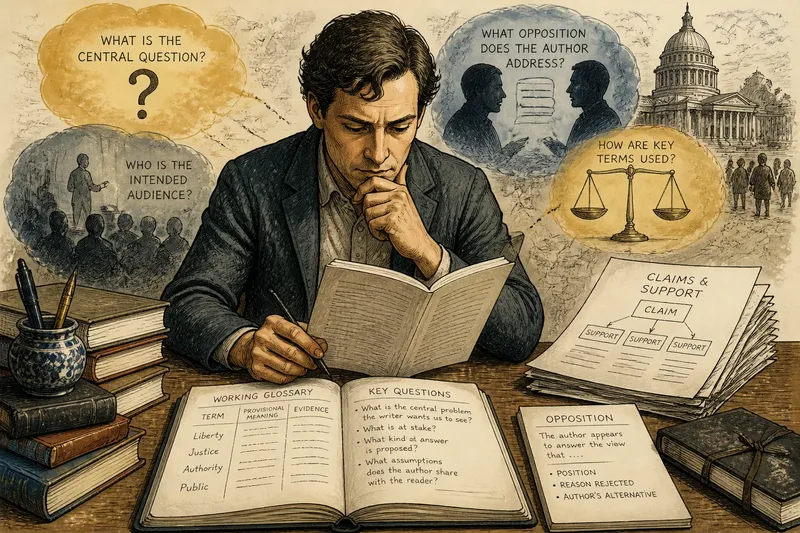
How do you read an unfamiliar political text without mistaking its vocabulary for its argument? A repeatable reading plan for an unfamiliar political text starts by locating the problem the writer wants readers to see, then traces the terms, audience, and opposition that shape the proposed answer. The point is not to suspend judgment forever. It is to make sure your judgment lands on the argument the text actually makes.
When the opening sounds like a verdict, find the question underneath
A political essay can begin with a confident declaration: a government is unjust, a law is necessary, a custom is harmful. That forceful opening can make the piece seem easier to understand than it is. Yet a verdict is usually an answer to a question the writer assumes the reader already recognizes.
On your first pass, read the opening and closing paragraphs, then scan the section headings and repeated phrases. Write a one-sentence account of the problem: “The writer is asking whether…” or “The writer wants readers to decide how…” Keep it as a question, not a summary of the writer’s solution.
Now check the body for the pressure behind that question. Is the author concerned with who may rule, what a law can demand, how wealth should be distributed, or what counts as civic responsibility? Those are different problems, even when a text uses the same broad word, such as freedom or justice.
Imagine you are reading an unfamiliar pamphlet arguing that a city should change its rules for public meetings. If you first write “the pamphlet supports stricter rules,” you have recorded its answer. If you ask whether the writer is trying to prevent intimidation, preserve orderly debate, or limit official discretion, you have identified questions that the body of the pamphlet must resolve. Those candidate questions are not interchangeable; look for which one its reasoning repeatedly returns to.
If the text seems to contain several central questions, mark them temporarily and look for the one that organizes the others. A writer may discuss education, work, and law while returning each time to the same underlying issue of authority. Don’t force a single neat question if the text genuinely shifts its concern; note where the shift occurs.
When a familiar word keeps changing, make a working glossary
Political vocabulary often carries ordinary meanings alongside narrower argumentative ones. A writer may use “liberty” to mean freedom from official interference in one passage and the capacity to take part in public life in another. Assuming the meanings match can make a real disagreement disappear—or create one where the author has not.
Choose a handful of terms that recur, especially words the writer uses to praise, condemn, or classify. For each, record a short provisional meaning and the sentence or passage that supports it. Add a note when the meaning changes. You do not need to resolve every ambiguity on the first pass; the glossary is a tool for keeping track, not a declaration that the word has one fixed meaning.
- Definition: Does the author explicitly say what the term means?
- Contrast: What does the text set against it?
- Consequence: What becomes permissible, forbidden, or valuable under this usage?
- Shift: Does the word take on a different job in another section?
A useful test is to replace the term with your provisional meaning and reread the sentence. If the sentence no longer makes sense, revise the gloss. This is like checking a map legend before following a route: the symbol may look familiar, but its local meaning determines where it leads.
When the intended reader is unclear, look for the knowledge the text assumes
Political writing rarely addresses a perfectly general audience. A passage may expect readers to recognize a public institution, share a moral premise, or feel the cost of a policy. The audience can be signaled by direct address, unexplained terms, familiar examples, or the kind of objection the author bothers to answer.
Ask who could read the text and immediately understand why its claims matter. Then ask who might need more explanation. A writer addressing lawmakers may treat a procedure as common knowledge; a writer addressing citizens may spend more time explaining why that procedure deserves scrutiny. These clues help distinguish the intended audience from everyone who might encounter the text now.
Do not confuse an author’s audience with the people discussed in the text. A writer can address property holders while arguing about people who lack property, or appeal to officials while describing the public affected by their decisions. Keep those groups separate in your notes.
Audience also affects tone. A sharp accusation may be aimed at persuading a skeptical reader, rallying a sympathetic one, or making an opponent appear unreasonable. Tone alone cannot settle which purpose is at work, but it can point you toward passages where the author anticipates resistance.
When the argument seems one-sided, identify the opponents it answers
A political text often argues with more than one visible target. It may name a rival position, answer an objection without naming its source, or criticize an assumption shared by the writer’s audience. If you read only the author’s claims, you can miss the debate that gives those claims their shape.
Mark phrases such as “some may object,” “it is often said,” or “the opposite view.” Then state the opposing claim in language its proponent might recognize. An opponent described only as foolish or selfish is not yet an argument; look for the actual principle or concern being challenged.
Separate three things: the position the author rejects, the reason offered for rejecting it, and the alternative the author advances. An author might object to a policy because it relies on a mistaken view of human behavior, because it produces an unwanted result, or because it violates a principle. Those are distinct lines of criticism. Notice which one carries the weight of the text.
When the opponent is implicit, use the passage’s contrasts and concessions to infer the target cautiously. Write “the author appears to answer…” rather than treating your inference as a quoted position. If no plausible opponent emerges, the text may be making a constructive case rather than staging a dispute.
When the prose feels dense, separate claims from support
Once you have a question, working definitions, audience, and opposition, the argument is easier to inspect. On a fresh pass, underline conclusions and mark the reasons offered for them. Signal words such as “therefore,” “because,” “unless,” and “yet” can help, but a writer may make a connection without announcing it.
For each major conclusion, ask what supports it. Is the reason a principle, an account of how an institution works, an example, or a prediction about what will happen? Then ask whether the conclusion follows from that reason, or whether a further assumption is doing quiet work. This is not a demand that every political text resemble a formal proof. It is a way to see where a reader’s agreement depends on accepting an unstated premise.
Keep descriptive and evaluative claims apart. “This rule gives officials discretion” describes a feature of the rule; “that discretion is unjust” evaluates it. The second claim may depend on a theory of fairness that needs its own attention. Marking the difference prevents a vivid description from passing unnoticed as a complete moral argument.
What should you ask before judging the argument?
How do I find the central question in a long political text?
Track the problem that recurs across sections and ask what decision or dispute the text wants readers to consider. If several questions remain, identify their relationship rather than forcing them into one.
What should I do when a key term has no clear definition?
Record how the text uses the word in different passages and compare its contrasts and consequences. Keep the meaning provisional until the pattern is clear, and mark any shift instead of smoothing it over.
How can I tell whom a political writer is addressing?
Notice direct appeals, unexplained background assumptions, and the objections the writer expects readers to recognize. Distinguish that audience from the people or institutions being discussed.
How do I identify an opponent the author never names?
Look for concessions, contrasts, and objections introduced as something “often said.” State your interpretation as an inference, then check whether it fits the author’s reply without caricaturing the other position.
When a clean summary hides a change in direction, follow the transitions
A summary can make a difficult text sound tidier than it is. Writers sometimes begin by diagnosing a problem, then change the standard by which they judge possible remedies. A passage may shift from asking what is effective to asking what is legitimate, or from describing a social practice to defending it. Transitions such as “even if,” “nevertheless,” and “that does not mean” often signal a qualification that matters.
Compare the opening question with the argument’s later turns. Has the writer narrowed the issue, introduced a new condition, or moved from a claim about what happens to a claim about what ought to happen? Note the change in your margin. A good reading account preserves those turns; it does not make every paragraph serve the first sentence.
When you finish, write a compact account before delivering a verdict
Close the book or document and write four sentences from memory: the central question, the author’s working meaning of a key term, the audience the text seems to address, and the main position or objection it answers. Add a fifth sentence for the argument’s main support. Reopen the text to check each sentence against a passage, then revise any claim that outruns the evidence on the page.
Only then ask whether the argument persuades you. You might accept its account of the problem but reject its proposed remedy, or agree with its principle while doubting a factual assumption. That is a more useful judgment than a verdict on the text as a whole, because it shows exactly where agreement ends.
A reading plan for an unfamiliar political text works best as a sequence of questions, not a rigid formula: What problem is being posed? What do its central words mean here? Who is expected to listen? Which position is being answered? What supports the conclusion? Keeping those questions in order lets you meet the argument on its own terms—and then decide, with clearer reasons, what you think of it.