The Long Argument Over a Fair Price
The fair price debate separates moral judgment from market price, helping you see what a transaction’s number can—and cannot—say about value.
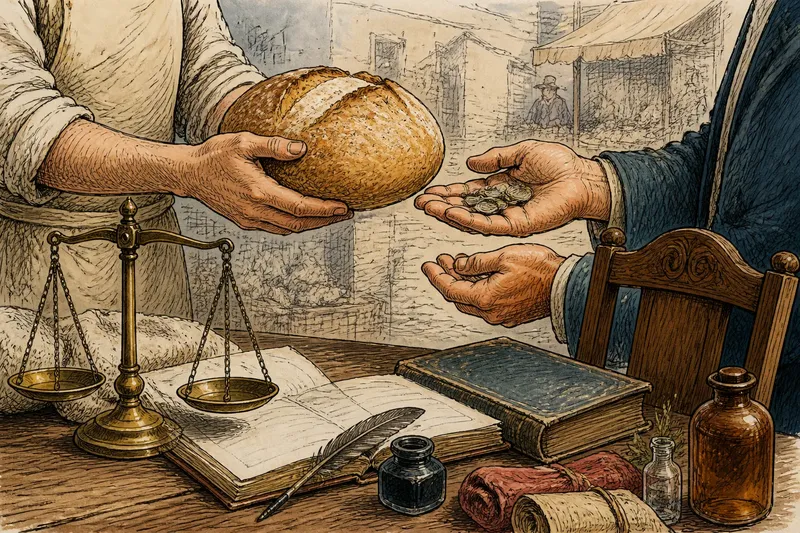
What makes a price fair when buyer and seller freely agree to it? The fair price debate starts with that question: a posted number records a bargain, but it cannot settle whether the bargain is just. To follow the argument, look at the exchange, the kind of value being claimed, and the conditions that shaped the price.
Agreement matters, but it is not the whole judgment
Imagine a baker selling a loaf to a neighbor. The neighbor accepts the price, takes the bread, and the baker receives payment. At the simplest level, both have chosen this exchange over the alternatives available to them. That matters: a price is not imposed in the same way as a theft or a tax. But agreement alone may not answer every moral question. Was the buyer under pressure? Did the seller conceal a serious defect? Could either party reasonably refuse?
A transaction can be voluntary in a narrow sense and still invite questions about fairness. Agreement tells us something about the parties’ choices. It does not automatically show whether those choices were informed, whether bargaining power was badly lopsided, or whether the terms fit obligations recognized in the community.
For a practical reading of a price dispute, note what is exchanged, what each party knows, and what alternatives each party has. A debate about bread differs from one about medicine, land, or a scarce service, even if each involves buyers and sellers.
Just price arguments ask what exchange should protect
Older arguments about a just price were not simply attempts to discover the one correct number hidden inside every object. They joined economic exchange to questions about moral conduct and social order. A price might be judged against customary practice, the circumstances of the exchange, the usefulness of the good, and the obligations of the people involved.
That approach begins with a concern many readers will recognize: a deal can look acceptable on paper while taking advantage of someone’s need or ignorance. A seller who exploits a buyer’s urgent dependence may make a profitable sale, but profit does not itself establish fairness. A buyer who uses superior information to take advantage of a seller may deserve criticism even if the seller technically consented.
“Just price” should not be treated as a synonym for a fixed official rate. Thinkers disagreed about how to make a fair judgment and which circumstances mattered. Custom could offer a public reference point, but it might preserve an unjust arrangement. A moral rule could restrain exploitation, but applying it required judgment about the good, the parties, and the context.
When you encounter the phrase, ask what work it does in the argument. Is it defending a customary range, condemning deception, protecting a vulnerable party, or calling for a public rule? These concerns are related, but they are not interchangeable. Identifying the purpose keeps a layered moral debate from becoming a hunt for one correct price.
Usefulness and exchange value answer different questions
Distinguish the value a person attaches to a thing from the price at which it trades. A glass of water may be indispensable to someone who is thirsty, while a glass in an ordinary setting is easy to replace. A market price reflects conditions of exchange, not a complete ranking of human needs or personal attachments.
Economists and philosophers have used “value” to mean usefulness, scarcity, labor, social importance, or the terms on which goods exchange. These meanings can overlap, but they do not collapse into one another. A high price does not prove that a good is morally important; deep personal attachment does not establish what another buyer will pay.
Say a family owns an old chair that belonged to a relative, and a dealer offers to buy it. The family’s starting point is a strong personal attachment; the dealer’s is the chair’s possible resale value. If both state what they value and consider the offer, the observable result may be a refusal or a sale on terms they accept. Either way, the market price does not resolve the difference between personal memory and exchange value.
A market price is like a thermometer beside a window. It gives a reading for a particular condition in a particular place; it does not describe the whole room or explain why someone feels cold. Price is informative, but it does not capture the full moral, personal, or social meaning of a good.
A market price is evidence, not a verdict
Later economic thought increasingly treated market prices as outcomes of interaction among buyers and sellers, shaped by supply, demand, information, and competition. This helped distinguish a description of market price from a moral judgment about fairness. The questions can inform each other, but neither answers the other by itself.
A price formed through open competition may offer evidence about what buyers and sellers currently accept. It can help coordinate decisions: producers see what people seek, while buyers compare available options. But market conditions matter. A seller with few rivals may have more room to set terms; a buyer facing urgency may have little practical choice; hidden information can prevent informed agreement.
Ask what the price leaves out. Does it reflect a genuine choice or a lack of alternatives? Were relevant facts available to both sides? Is the price temporary or supported by a durable pattern of demand? These questions do not make market price meaningless. They clarify what claim the number can support and when a moral argument needs evidence beyond it.
How should you judge a price dispute?
Does voluntary agreement settle fairness?
Agreement shows that the parties accepted the exchange, which is morally relevant. It does not by itself establish that both understood the terms or had reasonable alternatives.
Is a customary price automatically just?
Custom can provide a shared expectation and make dealings more predictable. But a familiar practice can still be challenged if it relies on deception, exclusion, or severe dependence.
Does a high market price prove high value?
It indicates that buyers and sellers are willing to exchange at that price under the conditions at hand. It does not establish that the good is socially essential or personally meaningful to everyone.
Can fairness be judged without a single correct price?
Yes. A judgment can focus on how the price was reached, what each party knew, and whether the terms exploit someone’s constrained position. That assessment may be clearer than pretending every good has one timeless fair number.
Compare the claims in a clear order
When weighing a dispute or reading a historical argument, keep these checks tied to a decision. They help distinguish the facts of an exchange from the standard used to judge it.
- What changes hands? If the good, service, or promise is unclear, define it before judging the price; if it is clear, move on to the parties’ choices.
- What alternatives does each party have? If one party faces urgent dependence or no practical substitute, examine whether that constraint shaped consent; if both have workable alternatives, assess the terms without assuming pressure.
- What does each party know? If a relevant defect, condition, or term is hidden, treat disclosure as a fairness concern; if both understand the same material facts, focus on the remaining terms.
- Which kind of value is being claimed? If the argument rests on usefulness, attachment, social importance, or exchange value, name that standard; if several are mixed together, separate them before drawing a conclusion.
- What does the market price indicate? If competition and informed choice appear central, treat the price as evidence of current exchange conditions; if scarcity, urgency, or limited rivalry dominates, qualify that interpretation.
- Which fairness standard is at issue? If the concern is deception, coercion, unequal bargaining power, or custom, state that principle and judge the transaction against it; if no standard is identified, ask what the accusation of unfairness means.
Imagine a tenant who needs a broken window repaired before cold weather and receives one offer from a local glazier. The starting facts are that the tenant has an urgent need, one available offer, and an estimate whose terms can be examined. The tenant checks whether the estimate describes the work and materials, asks what alternatives are realistically available, and compares the stated charge with another informed offer if one can be obtained without worsening the problem. If the scope is clear and the alternatives are comparable, the tenant can judge the offer as a voluntary exchange while still deciding whether the limited choice makes it troubling. If the terms are vague or the urgency is being used to conceal extra work, the tenant can ask for clarification or seek another qualified glazier. The result is not a universal fair price; it is a better-grounded judgment about disclosure, choice, and the terms offered.
This order avoids two shortcuts. One declares every agreed price fair because both parties said yes. The other assumes that a morally important good must have a price fixed without regard to scarcity or circumstances. The fair price debate is useful because it keeps these questions distinct while showing how they meet in an actual exchange.
The fair price debate is less a hunt for a universal number than a disciplined way to interpret one. A market price can coordinate decisions and reveal what people will trade under particular conditions; moral reasoning can ask whether those conditions deserve acceptance. When someone calls a price fair or unfair, the most useful next question is not simply “How much?” but “By what standard, and under what circumstances?”